


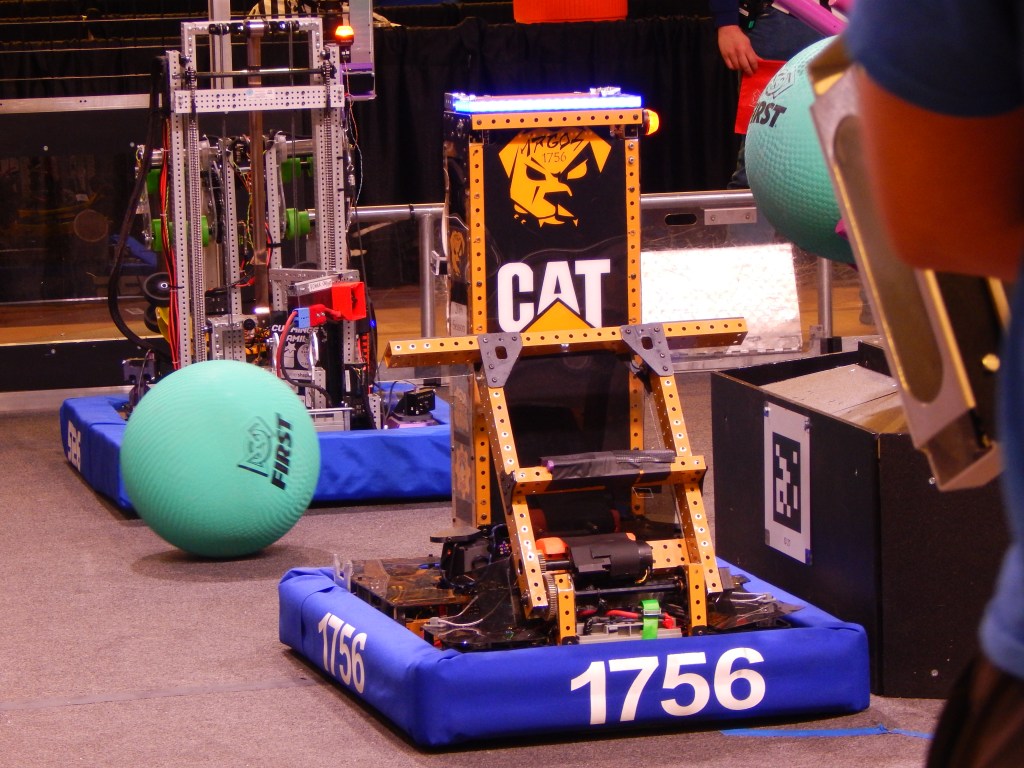
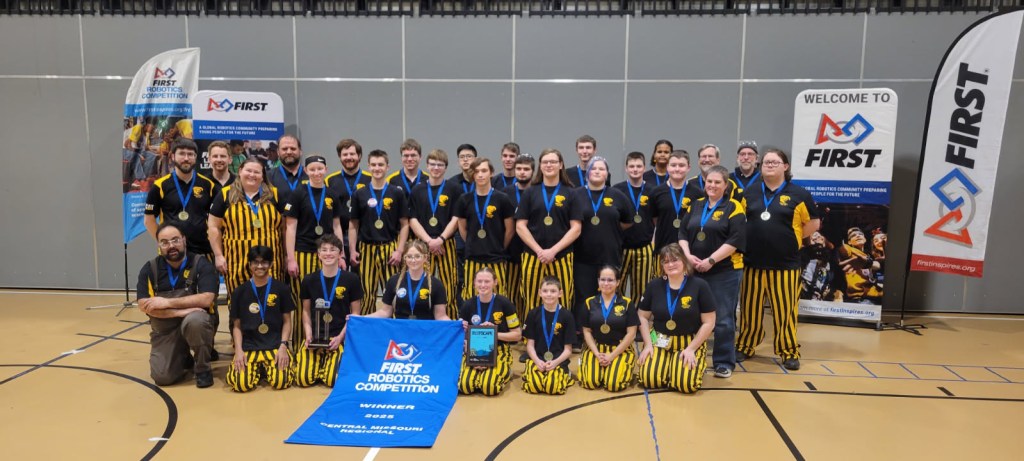
The Argos robotics team, a community team composed of Limestone, IB, and homeschool students, won the Central Missouri Regional(CMR) on March 8, earning an award for “Excellence in Engineering” and qualifying for the World Championship. The Central Missouri Regional is one of many First Robotics Competition(FRC) regionals. It was Argos’s first regional of the 2025 REEFSCAPE season.
Argos was ranked first overall by the end of qualification matches. With that, Argos was able to pick their first team to be on their alliance, alliance one, for playoff matches. Playoffs are a double elimination bracket until finals which are a best of three. With that being said, the alliance was able to win all of their matches. In finals one, the alliance won 138-94 against alliance three. While finals match two was a more intense match, alliance one still won, 152-117.
Every year, teams receive a video of the game animation and a “game manual” that includes a description of the tasks you need to do to earn points and how to get ranking points(RP). Ranking points are what decides where you are ranked during competitions. Every competition has the same exact field and game elements throughout the whole season.
This year the game is called REEFSCAPE, where you have to place coral (PVC pipe) on the reef, and take algae off the reef. You can score the coral on four different levels on six sides of the reef (a multi-pronged metallic structure). For the algae (giant kickballs) you can place them in the net which is eight feet tall or the processor which is a hole in the wall. While the game seems intense, each match only lasts two and a half minutes.
The first 15 seconds robots are running off pre-programmed code which is the autonomous period, aka autos. Once autonomous is over the next 135 seconds is human driven play, tele-op. Teams can earn six RP every match, three from winning, one from placing five coral on all four levels of the reef, one from scoring 15 barge points, and one from having all robots on your alliance move and one coral has to be scored during the autonomous period.
“The game is a unique blend of strategy and robot composition,” sophomore Conner F. said. “For example, having a robot that can score algae might pair well with a robot that focuses on coral, and strategy is needed to coordinate that.”
There is a lot of strategy that is needed during competitions. Before every match multiple people from each team on an alliance talk to each other about what their robot can and can not do. The strategy of a match can make or break how the match turns out. While the drive team is who decides what the game plan is, they use scouting data from the scouts to make sure they win the match or get the most RP.
“During the competition I did a mix of both scouting, in the stands, and going down to the field doing media by taking photos of the robot during the match,” sophomore Sydney N. said.
For the scouts on Argos they have to keep track of three or more teams at a regional. They write down what each of their robots scores during autos, what they score during tele-op, and end game. The scouting is very useful for upcoming matches and alliance selection
There are many different jobs on the team during competitions: driver, operator, human player, technician, media and scouters. Every single job is as important as another job. While the drive team always gets the most recognition, they can’t win every match without the scouts. Every student that isn’t on drive team is a scout, which is about 14 of the 18 students. The other four students are on the drive team. The IB drive team students are sophomore Conner F., senior Grace H. and junior Sarah P.
“I feed the robots during the matches, help fix any damage done to the robot, and talk to judges,” Sarah said. “During the build season I worked on our intake, the elevator, wiring and more.”
The build season is the first six weeks of the season. Kickoff for the season was Saturday Jan. 4, 2025. During the build season Argos prototypes, builds, and programs the robots. Every year they build two robots, practice and competition. The practice bot is built to see if the concept of the robot works. Not only is it used for testing but it is for programming. The programming team spends a lot of time on code, camera and making sure everything runs smoothly, code-wise.
After about five weeks of build season Argos moved out to the practice field, a Caterpillar warehouse. At the practice field there is another Peoria team, 1736 Robot Casserole. Both Argos and Casserole worked together to build the field. Both teams have been using the field to run matches, test vision and run autos.
“Some difficulties we have faced include climbing the deep cage, algae getting stuck in our intake system, and vision lining up to the reef,” Conner said.
With the minimal days after CMR that Argos had to make the robot better before their next regional they focused on certain aspects of the robot.
“We plan on finding a new way to hold the algae and are working on making the vision more consistent while lining up with the reef,” Crew F. said.
The next regional that Argos is competing at is the Central Illinois Regional. It is located in the Renaissance Coliseum at Bradley University and is free admission to the public. Practice matches start March 20, 2025 at noon and go until 6 P.M. The next day, March 21, is the start of qualification matches. They will go from 8:50 A.M. to 5:45 P.M. with a lunch break from noon to 1 P.M. Then on Saturday qualification matches go from 8:50 A.M. to noon. After that alliance selection will start. Once that is over, around 12:30 P.M. lunch will start. At 1:30 P.M. playoffs will start and that is a double elimination bracket. In between some playoff matches there will be awards given out to teams from judges.
You will be able to watch the matches on Twitch at https://www.twitch.tv/firstinspires5. You can also view the match scores and times for matches at https://www.thebluealliance.com/event/2025ilpe.
 Illini Bluffs High School Tiger Times
Leave a comment